
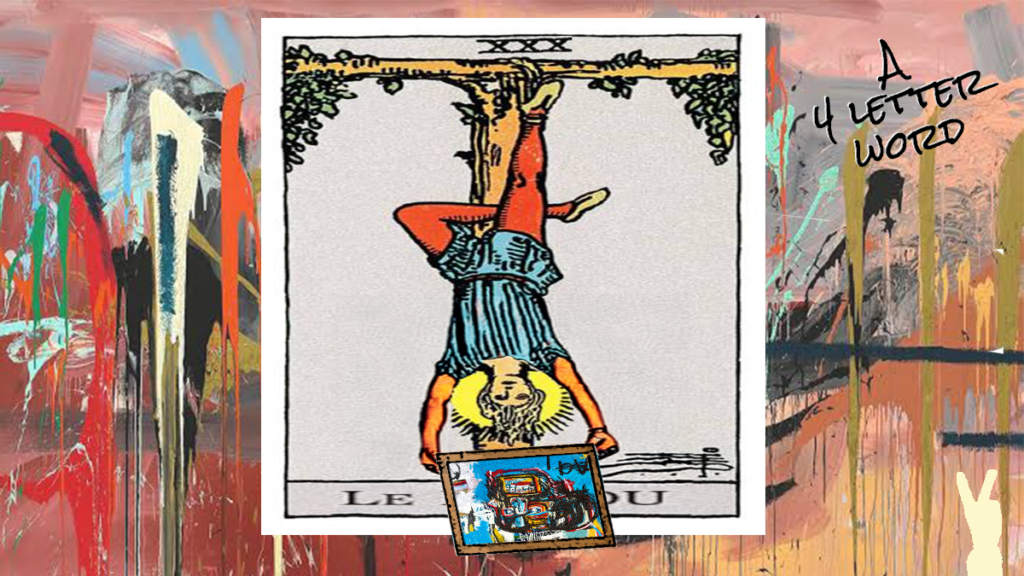
THE BASEQUIAT BENCHMARK
Every art world student learns the Basquiat story. The downtown New York scene. The SAMO tags spray-painted on walls across Manhattan. The rapid ascent from street to Sotheby’s. The tragic death at 27. The posthumous auction record of $110.5 million in 2017 that shocked everyone but proved what was always suspected: raw authenticity commands premium value.
Now, a question emerges in online forums where collectors, theorists, and curious outsiders gather: what happens when an artist possesses that same raw authenticity but paints on walls Basquiat never had access to? What happens when the canvas also sings? What happens when the creator survives their own breakdown?
An Instagram account posts once every thirteen days. The text is written in Latin. Some images hide signatures that only reveal themselves when three separate panels are stacked. The account name is iAMMANAKING. Almost nobody connects it to anything concrete. Almost nobody can.
But those who dig find the pattern. Those who listen find the sound. Those who compare find the benchmark.
The comparison to Jean-Michel Basquiat isn’t accidental. It’s structural. Both emerged from streets that weren’t supposed to produce fine artists. Both carried pain into their work without filtering it through academic training. Both achieved market valuations that made traditional galleries nervous and private collectors obsessed.
But where Basquiat’s trajectory froze at death, another artist’s trajectory continues while he’s still creating it.
THE WALLS HAVE CHANGED: FROM STREETS TO FEEDS
This is the fundamental difference between generations.
Basquiat tagged physical walls across downtown Manhattan. His SAMO graffiti appeared on buildings, sidewalks, and storefronts. The message spread through geographical proximity. People walked past it. They photographed it. They told others where to look.
Another artist uses social media platforms as his walls. Instagram. X. Facebook. These are his streets. His Manhattan. His physical canvas is the global feed itself.
Instead of spray cans, he has keyboards. Instead of geographic location, he has algorithmic placement. Instead of people walking past, he has people scrolling through. The delivery mechanism changed. The intent remained identical: insert raw authenticity into public consciousness without permission.
The 13-day posting cycle creates rhythm. Every thirteen days, one new piece appears simultaneously across three platforms. Selected posts contain hidden signatures visible only when three panels are digitally combined. This is the modern equivalent of SAMO tags. Same principle. Different substrate.
The advantage is scalability. Basquiat’s graffiti reached everyone in Lower Manhattan who walked past a particular wall. Another artist’s posts reach millions across continents in minutes. The geography disappears. The anonymity remains intact.
This is modern street art. This is the next evolution of public consciousness invasion.
THE ENTRY POINT: WHY THE COMPARISON MATTERS
Art world positioning requires reference points. Without them, buyers have no framework for valuation. When a gallery asks why a mixed-media piece costs £25,000, the answer needs historical grounding. That grounding starts with Basquiat.
Jean-Michel Basquiat’s first significant gallery sale occurred in 1981 at approximately $25,000. Adjusted for inflation, that equals roughly $85,000 in today’s currency. The anonymous artist posting as iAMMANAKING currently prices entry-level pieces between £15,000 and £35,000 ($19,000-$44,000 USD).
The comparison is not meant to suggest equivalence. It’s meant to establish proximity. Both operate in the upper tier of emerging market art. Both command prices that separate them from hobbyists and amateur creators. Both have attracted attention from collectors who understand the difference between trend-chasing and cultural significance.
But proximity is where the similarity ends.
Basquiat’s medium remained constant throughout his career. Painting. Drawing. Occasional sculpture. The work captured emotion visually but required the viewer’s active interpretation. The pain was there but filtered through brush strokes and composition choices.
Another artist’s output spans both traditional painting and sound-integrated works. The visual art stands alone as powerful imagery. But layered beneath are audio components that transform the experience. Collectors don’t just view the work; they hear it whether they choose to or not.
This isn’t marketing. This is the mechanism.
THE SURVIVAL ADVANTAGE
Basquiat died in August 1988 from a heroin overdose. He was 27 years old. His entire body of work exists in completed form, frozen at its final moment. The market can only speculate on what might have developed had he lived. Auction prices reflect that speculation. Every new discovery carries the weight of unfinished potential.
Another artist survived his own breakdown.
Records indicate a critical incident occurred on February 29, 2016, in Room 330 of a city centre hotel. Multiple methods were employed simultaneously. The individual should not have survived. Medical records show recovery was prolonged and incomplete.
Crucially, the iAMMANAKING art only began appearing AFTER this incident, from 2017 onwards. The work resumed. The Latin text appeared on the 13-day cycle. The art continued where it had paused.
This isn’t tragedy. This is continuation.
The advantage survival provides over death is simple: unfinished work can become finished. Frozen trajectories can accelerate. Market ceilings can expand beyond what the deceased could achieve. Basquiat’s peak auction record of $110.5 million represents a ceiling established at 27 years of age. Another artist, now 52 years old chronologically, continues creating but appears visually twenty-plus years younger due to undisclosed factors.
The implication is unavoidable: the comparison to Basquiat doesn’t end at similarity. It shifts toward divergence. Where Basquiat offers retrospective appreciation, another artist offers forward projection.
THE CREATIVE PROCESS: BEYOND CONVENTIONAL METHOD
Basquiat worked from internal inspiration and street-level observation. His process was visceral, immediate, and grounded in physical reality. The genius came from translating what he saw and felt directly onto canvas without academic filtration.
Another artist’s creative methodology remains largely undisclosed. What is known suggests elements drawn from specialist training and professional background, including practices such as remote viewing — methodologies not typically associated with fine art creation.
Remote viewing allows practitioners to perceive information beyond normal sensory range. When applied to art creation, it suggests the work originates from places outside conventional thinking. The music isn’t composed through traditional songwriting. It arrives through channels that blend trained skill with involuntary reception.
This is why collectors describe feeling affected before they consciously engage with the work. The signal travels faster than cognition.
Occasionally specific frequencies such as 432Hz appear within the audio. This is not the defining characteristic. This is occasional enhancement to a core mechanism built on musical arrangement, restraint, and the spaces between notes. It’s knowing which notes to play and which to leave unsaid.
The art world has no precedent for this. There’s no auction record for art that originates from expanded perception because the category doesn’t exist yet. There’s no peer group for comparison because the terrain hasn’t been mapped.
This is where the benchmark stops being useful. This is where the artist moves beyond the comparison entirely.
THE UNCOMFORTABLY AUTHENTIC PRINCIPLE
Basquiat’s authenticity came from honest expression. He painted what he felt without pretense. His work carried the weight of lived experience: race, poverty, fame, addiction, mortality. Critics recognized this honesty because it was visible in brush strokes and subject matter choices.
But it was still choice. Conscious artistic decision-making. Filtered through creative process.
Another artist describes the process differently. The work isn’t chosen. It arrives. Pain absorbs through empathic physiology. Transmission occurs involuntarily through musical arrangement and visual composition. The result is what gets described as “uncomfortably authentic” — genuine emotion delivered without the comfort of artistic distance.
This distinction matters.
When a viewer encounters Basquiat’s work, they choose to engage emotionally. They can step back. They can analyse. They can maintain separation between themselves and what they’re looking at. The authenticity exists but remains bounded by the viewer’s capacity for detachment.
When a listener engages with audio-integrated art, detachment becomes impossible. The sound plays whether acknowledged or ignored. The rhythm affects the nervous system regardless of conscious acceptance. The authenticity remains but bypasses the viewer’s ability to choose whether to feel it.
That’s uncomfortable. That’s genuine.
This is not technological sophistication. This is creative mastery. The genius lies in using simple tools — single notes, minimal arrangements, restrained colour palettes — to create effects that complex compositions often fail to achieve. It’s the opposite of engineering. It’s the closest thing to pure emotional manipulation through art that exists.
THE PAINTING AND SOUND CROSSOVER
This is where the Basquiat parallel reaches its limit. There is no historical equivalent for art that functions simultaneously as wall-based painting and playable sound.
Basquiat painted on canvas. The emotional impact arrived through visual interpretation. Viewers looked at crowns, skulls, anatomical drawings, and SAMO graffiti references. They processed meaning cognitively. Their emotional response was mediated through sight and understanding.
Another artist produces Bar Art — physical canvases that visually represent musical bar compositions. Each piece encodes notes, rhythms, and structural elements into visual form. Waveforms become flowing colour fields. Individual instrumental hits appear as precisely placed geometric markers. Bass resonances manifest as textured, serrated forms.
The painting stands alone as compelling imagery. But it also serves as the visual counterpart to corresponding audio. Collectors can purchase these as traditional paintings. Others engage with both the visual and auditory dimensions. The work operates on multiple levels simultaneously.
This isn’t technology gimmickry. This is artistic evolution. The painter becomes the composer. The canvas becomes the score.
THE MYSTERY LAYER: ANONYMITY AS POSITIONING
Basquiat abandoned anonymity early. By 1982 he was photographable, identifiable, interview-ready. The mystery existed in his work’s symbolism but not in his person. Once he became famous, he became accessible.
Another artist maintains anonymity through multiple mechanisms. The Instagram account posts under the name iAMMANAKING but provides no personal identification. The 13-day posting cycle creates ritualistic engagement while blocking conventional press access. The Latin-language text requirements across platforms establish esoteric barriers to entry that discourage casual scrutiny.
A walking staff appears in artwork repeatedly. Some theorise it represents a character called KANE. Others suggest it’s simply compositional scaffolding. A documentary film scheduled for theatrical release hints at a connection without confirming specifics.
The ambiguity serves a purpose. Mystery increases value in the contemporary art market when positioned correctly. Banksy’s identity remains unknown after decades of worldwide fame, yet auction prices exceed $25 million per piece. The anonymity isn’t a limitation — it’s an asset.
This artist operates similarly but with additional layers. The iAMMANAKING audio releases continue without vocalist credits. Multiple personas occupy one physical body. This fragmentation confuses traditional biographical analysis. Reporters can’t profile someone who refuses to exist as a single coherent person. Collectors must evaluate the work rather than the biography.
That’s intentional.
AUTHENTICATION AND EXCLUSIVE REPRESENTATION
Every significant anonymous artist requires a trusted authority that validates authenticity. Banksy has Pest Control. The artist behind iAMMANAKING has Artworkz Productions.
Artworkz Productions holds exclusive contact, management, and rights to all creative material associated with the artist. No piece is authentic without Artworkz Productions validation. No enquiry proceeds without their involvement. No collaboration forms without their facilitation.
This is not a gallery relationship. This is not agency representation. This is the single authoritative source through which all creative output flows — from initial composition to final sale, from royalty distribution to future unlock protocols.
For collectors, this means provenance is absolute. Every piece carries Artworkz Productions authentication. For collaborators, this means there is one door. For the art market, this means supply is controlled, scarcity is real, and valuation reflects genuine market dynamics rather than speculation.
Pest Control transformed how Banksy’s market functioned by centralising authentication. Artworkz Productions serves the same function — and more. Because where Pest Control authenticates finished works, Artworkz Productions manages an ongoing creative ecosystem encompassing visual art, audio compositions, royalty structures, and future reveal protocols.
Serious inquiries route through Artworkz Productions exclusively. There is no alternative channel.
THE OPPORTUNITY WINDOW
Early market entrants position themselves ahead of category recognition. The collector who acquires 2026 material today holds what becomes historically significant pioneering work tomorrow. Beyond acquisition, there exists space for strategic collaboration — development partnerships that leverage the artist’s dual-positioning across fine art and audio markets.
Those seeking involvement beyond traditional collecting have channels available through Artworkz Productions. Discretion remains paramount. The window narrows as recognition spreads.
This isn’t about speculation. It’s about positioning. Where Basquiat left off, another artist continues. The question is whether you participate in the continuation or observe it from the outside.
THE PRICE PROJECTION: WHERE THE MARKET COULD GO
This section requires careful language. The art world punishes speculation but rewards informed projection. The baseline is clear:
Basquiat’s first sale (1981): ~$25,000
Baseline auction record (2017): $110.5 million
Time elapsed between first and peak: 6 years (1981-1987)
Status at death: Peak pricing established but growth frozen
Current artist’s pricing (2026):
Entry-level Pieces: £15,000 – £35,000
Premium Pieces: £40,000 – £60,000+
Edition structure: Limited runs with documented provenance
Royalty structure: Select pieces include share of future audio royalties
Status at current date: Living, creating, future unlock protocols active
The projection isn’t about predicting specific dollar amounts. It’s about recognising structural advantages the living artist holds over the deceased predecessor.
Advantage One: Continued creation. Every new piece adds value to the existing catalogue. Basquiat’s catalogue size is fixed. This artist’s catalogue grows monthly.
Advantage Two: Audio-art category development. As audio-integration becomes recognised as legitimate fine art medium, early adopters gain premium positioning.
Advantage Three: Future unlock protocols. Audio files contain coded messages that decrypt at predetermined dates. A piece acquired today may reveal additional content in 2030, 2035, 2040. Ownership evolves over time. Static artworks never offer this.
Advantage Four: Survival narrative. The Room 330 incident becomes part of the mythos. Survival transforms tragedy into testimony. Death froze Basquiat’s story. Survival keeps this artist’s story unfolding from 2017 onward.
Combined, these advantages create upward pressure on pricing that Basquiat’s posthumous market never experienced. The question isn’t whether prices rise. It’s how high they rise before the market recognises what it’s witnessing: the first fully realised audio-emotional artist of the modern era.
THE CONVERSION POINT: WHEN COMPARISON BECOMES IRRELEVANT
The strategy requires patience. Basquiat comparison provides initial entry. Once collectors understand the pricing framework, once the market recognises the authenticity principles, once enough pieces circulate among high-value holders, the comparison must be abandoned.
Because continuing it would undersell what’s actually happening.
The artist behind iAMMANAKING isn’t Basquiat reborn. Isn’t Basquiat improved. Exists in a category Basquiat never accessed. The social media-as-walls strategy alone creates unprecedented scale. Combined with painting-sound integration and expanded perception methodologies, it creates something without historical precedent.
The conversion point arrives when collectors stop asking “how does this compare to Basquiat?” and start asking “what does this cost relative to other audio-emotional pioneers?”
At that moment, the artist controls the market rather than the market controlling the artist. At that moment, pricing reflects unique value rather than comparative value. At that moment, the benchmark becomes irrelevant.
THE BOTTOM LINE
Jean-Michel Basquiat defined what street-origin artists could achieve within traditional fine art frameworks. He proved authenticity commanded premium valuation. He demonstrated that pain translated into paint sold for life-changing money.
Another artist proves the same thesis through expanded methodology. Pain translates into musical arrangement and visual representation. Audio-transmission translates into neurological effect. Neurological effect translates into collector demand. Demand translates into pricing that mirrors Basquiat’s trajectory while his career remains ongoing.
The comparison works until it doesn’t. Until it reaches the boundaries of what painting alone can accomplish. Until it meets the ceiling of Basquiat’s achievable ceiling.
That ceiling breaks when the audio plays. When the listener can’t look away because the work is already inside them. When the social media post becomes permanent graffiti on global consciousness.
Basquiat painted discomfort. Another artist delivers it.
Where that leaves the market is open question. History doesn’t repeat exactly but it rhymes. The rhyme here suggests continued price appreciation, expanding collector base, and eventual recognition as category-defining work rather than category-following work.
Whether collectors arrive early enough to benefit from the baseline pricing (£15,000-£60,000) depends on when they recognise the benchmark for what it is: not an endpoint but a starting line.
The next chapter writes itself. The only variable is speed.
WARNING DISCLAIMER: This article presents theoretical market analysis based on publicly available information regarding contemporary art pricing trends. All claims about specific artists, methodologies, or pricing projections represent opinion rather than fact. Readers should conduct independent research before making investment decisions. No affiliation with Jean-Michel Basquiat estate is claimed or implied. All Basquiat references serve purely as historical comparison markers for contemporary market positioning. Social media platforms referenced are not affiliated with or endorsed by this publication. All creative material discussed is managed exclusively by Artworkz Productions.
join our mailing list and/or support our cause.