
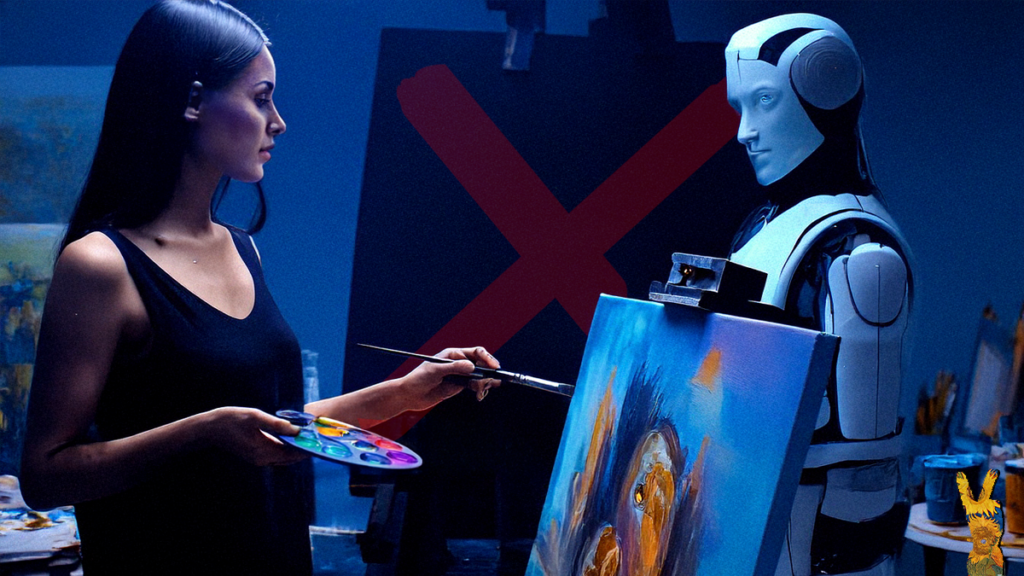
You didn’t notice them coming. There were no press releases, no parliamentary debates, no public consultations.
They arrived quietly—in code, buried in terms of service, embedded into the infrastructure of creation itself.
Algorithms now gatekeep what art reaches audiences. And unlike human curators, they don’t explain why they chose you—and why they silenced everyone else.
The Black Box Curator
Major platforms serving visual art—Instagram, DeviantArt, ArtStation, Pinterest—process millions of uploads daily. Human moderators cannot possibly review each piece. So automated systems decide what gets promoted, suppressed, or deleted.
The problem? These systems are trained on datasets reflecting existing biases. Content flagged as “problematic” tends to be content that already challenges dominant narratives. Satire reads as harassment. Historical analysis reads as misinformation. Political commentary reads as harmful misinformation.
Independent researchers at Oxford Internet Institute found that algorithmic moderation disproportionately affects [Read Snopes’ guide on spotting AI images for practical detection tips].:
- Works containing nudity in classical or medical contexts
- Satirical depictions of political figures
- Historical imagery involving conflict or protest
- Text-heavy artwork containing controversial terminology
The Generative Problem
Generative AI changed everything.
Tools like Midjourney, DALL-E, and Stable Diffusion process billions of prompts daily. Each one filtered through safety filters trained to prevent “harmful outputs.” The definition of harmful? Unclear. Shifting. Subjective to whoever holds the keys.
A user prompt requesting “historical photograph of 1960s civil rights march” may return sanitized imagery excluding police violence or tear gas—not because the event didn’t happen, but because the filter deemed such content “potentially distressing.”
History becomes editable. Reality, soft-focused.
Worse still: platforms hosting AI-generated content apply stricter moderation to certain subjects regardless of artistic intent. A portrait of a politician as a cartoon character triggers different flags than the same treatment applied to a religious figure, a monarch, or an activist. The bias is baked in.
Case Study: The Vanishing Series
Artist Marcus Thorne (name changed for protection) created a twelve-piece series examining surveillance culture, featuring composite portraits of British intelligence officers constructed from publicly available photographs.
Upload to three major platforms resulted in takedowns within minutes of posting. Appeals failed. Final response from one platform: “Content violates community guidelines regarding potential doxxing of government personnel.”
Thorne wasn’t doxxing anyone—the images came from open parliamentary records, police charity fundraisers, press conferences. But the algorithm couldn’t distinguish between malicious exposure and artistic critique. It saw faces associated with power and shut it down.
“I spent six months creating work about power structures,” Thorne told us. “The power structures decided my art shouldn’t exist. And I couldn’t appeal to anyone human who’d listen.”
Training Data Transparency
Here’s what companies won’t disclose: their training data sources.
Which artworks informed the model? Which artists’ work was scraped without consent? Which ideological frameworks shaped the output filters?
No one knows. Trade secrets, they say. Proprietary technology. National security considerations.
Meanwhile, artists find their style reproduced without compensation. Their imagery transformed beyond recognition. Their voices drowned out by machines mimicking their labour.
The European Union’s AI Act requires transparency from major developers—but enforcement lags, exceptions abound, and many platforms operate outside EU jurisdiction anyway.
The Platform Problem
Even independent platforms implementing stricter moderation policies face pressure from payment processors, hosting providers, and advertising networks. Stripe can freeze accounts. AWS can terminate servers. Advertisers can withdraw sponsorship.
No single company needs to ban you. The system works by distributed enforcement—each node applying its own standards, collectively achieving censorship nobody explicitly planned.
What Can Artists Do?
First, recognise the reality. Your work exists on platforms owned by corporations answerable to shareholders, regulators, and public sentiment—not artists.
Second, diversify. Don’t rely on one channel. Build direct relationships with audiences through email lists, independent websites, physical exhibitions.
Third, document everything. Screenshots, version histories, communications. If your content disappears, preserve evidence of what existed before.
Fourth, reach out directly to independent publishers committed to free expression. We welcome work across all creative disciplines—especially material that platforms reject. Contact us at here: contact page . No automated filtering. No algorithmic gatekeeping. Just art.
The Bottom Line
We’re entering an era where machines decide what culture survives. Not based on quality, meaning, or truth—but based on patterns learned from training data filtered through commercial and political interests.
This isn’t censorship in the old sense. No government minister ordering a ban. No official decree. Just code executing instructions written somewhere, sometime, by someone you’ll never meet.
And yet the result is identical: less art reaches fewer people.
Art demands space to breathe. To offend, to provoke, to unsettle. Algorithmic moderation offers none of these freedoms.
Who owns your audience? Who controls your distribution? Who decides whether your work sees daylight?
Better to ask before it’s too late.
Disclaimer: This article is for educational and entertainment purposes only. All content presented constitutes creative expression and artistic commentary. No claims are made regarding possession of confidential, classified, or privileged information. References to specific incidents are based on anonymous contributor accounts and public reporting. Readers are encouraged to conduct independent verification of any assertions made herein. Artworkz Productions reserves all rights to all creative materials published under our banner. Reproduction without written permission prohibited.
© Artworkz Productions | All Rights Reserved
join our mailing list and/or support our cause.