
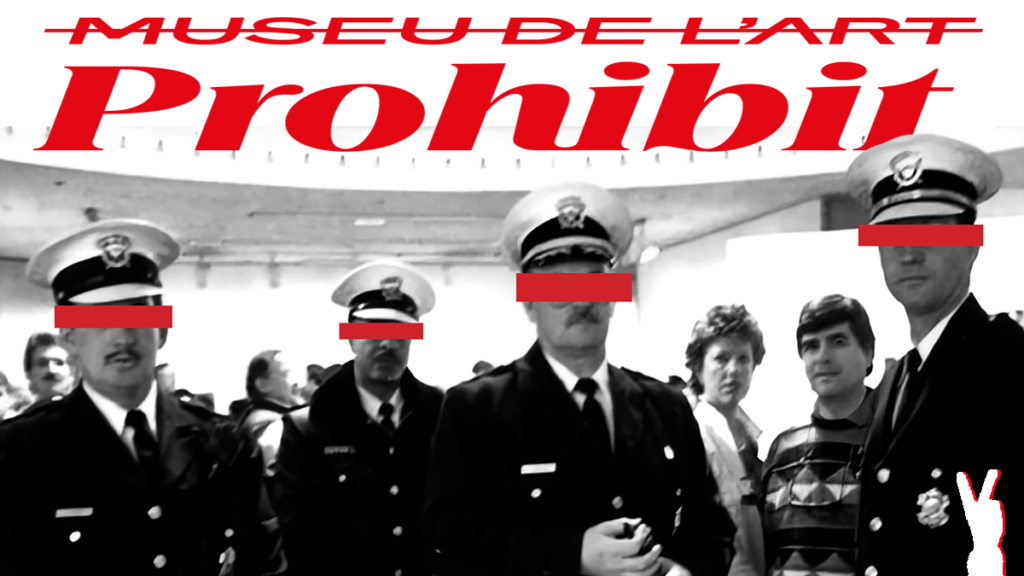
THE MUSEU DE L’ART PROHIBIT CLOSURE: WHAT THEY ARE NOT TELLING YOU
THE UNCENSORED ARCHIVE | INVESTIGATIVE ANALYSIS
Unverified Claims Under Review | Date: 13 July 2026
THE OFFICIAL STORY
When Museu de l’Art Prohibit — Europe’s only museum dedicated to censored, banned, and prohibited art — ceased operations, the public was given a familiar narrative. Financial difficulties. Administrative challenges. The usual explanations trotted out when institutions that hold uncomfortable things are quietly shuttered.
Nobody asked the harder questions. Nobody looked at the timing. Nobody asked what was about to be exhibited.
WHAT SOURCES NOW SUGGEST
According to unconfirmed reports from individuals with proximity to the museum’s final operational months, the closure of Museu de l’Art Prohibit was not the result of financial mismanagement or administrative failure. Rather, it coincided with preparations for what may have been the most controversial exhibition in the institution’s history — and arguably in European art history.
Sources allege that the museum had entered into communication with an anonymous British conceptual artist whose identity remains unconfirmed. The proposed exhibition reportedly included works never before displayed publicly, including pieces utilising what the artist terms iAMF ART (iAM Frequency Art) — a form of frequency-based art that claims to produce measurable physiological and psychological effects in those who engage with it.
The collection, described by one source as “unlike anything the art world has encountered,” allegedly contained additional works of controversial significance whose nature has not been disclosed. What is known, according to these reports, is that the scope and content of the proposed exhibition went considerably beyond conventional provocative art.
THE OWNER’S CONNECTION
Central to understanding this situation is Tatxo Benet, the museum’s founder and owner. A figure well-connected within Catalan high society and the European art world, Benet has maintained an unusually low profile since the museum’s closure was announced.
Reports surfaced briefly suggesting a prior relationship between Benet and the anonymous British artist — described as a “mutual friendship cultivated over several years” through private art collector circles. These claims were quickly retracted from circulation, with the original source issuing a correction that cited “misinformation regarding personal associations.“
However, the speed of the retraction itself raised questions. If the connection was simply inaccurate, why the urgent correction? Some within the Barcelona art community speculate that the retraction came under pressure rather than voluntary — a common occurrence when certain relationships are better kept out of public view.
Benet’s known association with elite European networks — including connections to prominent collectors in Spain, Italy, and the United Kingdom — positions him to understand both the risks and rewards of hosting such a controversial exhibition. Whether he proceeded independently or as part of a broader network of supporters remains unclear.
THE TIMELINE PROBLEM
The official explanation for the museum’s closure cites financial and administrative factors. However, independent review of the timeline raises questions that have yet to be addressed publicly:
- Communications between museum staff and representatives of the anonymous artist reportedly intensified in the weeks preceding closure
- Internal discussions regarding the exhibition were allegedly leaked to parties outside the museum
- The closure occurred abruptly, without the wind-down period typical of financial insolvency
- Attempts to clarify Benet’s personal involvement were met with silence or rapid retractions
If financial difficulties were the sole cause, one would expect a gradual reduction in operations, public fundraising appeals, or attempts to restructure. None of these were observed in the manner typically associated with institutional financial collapse.
THE UK SECURITY DIMENSION
Perhaps the most significant allegation — and the most difficult to verify — concerns the role of external pressure in the museum’s closure.
Sources with connections to European intelligence networks suggest that once word of the artist communications leaked, pressure was applied to the Spanish government through diplomatic channels. The reported origin of this pressure: United Kingdom security services.
The rationale, if these reports are accurate, relates to the artist’s alleged background. The anonymous creator is widely rumoured within certain circles to possess training experience connected to US/UK law enforcement, military, and government programmes. If the iAM Frequency technology — or the broader body of work intended for exhibition — contained references to classified methodologies, the potential for exposure would represent a significant security concern for British intelligence.
Whether this pressure was applied directly through official UK-Spain intelligence cooperation channels, or indirectly through what one source described as “European Illuminati-influenced networks” with interests in suppressing certain types of information, remains a matter of speculation. Neither the UK nor Spanish governments have commented on any such allegations.
THE iAMF FACTOR
Central to the controversy surrounding the proposed exhibition is the question of what iAMF aka iAM Frequency Art actually is.
The artist has never publicly explained the mechanism in conventional scientific terms. Descriptions from those claiming familiarity with the work range from “bioacoustic therapy encoded into visual media” to “something closer to remote viewing technology rendered as art.” The known use of hypnotic and astral projection states in the creative process adds further ambiguity.
If Museu de l’Art Prohibit was preparing to display works that genuinely produce measurable effects on viewers — works that blur the boundary between art and something else entirely — the implications extend well beyond the art world. They touch on questions of public safety, cognitive influence, and the regulation of technologies that do not fit neatly into existing legal frameworks.
THE LIDIA PEDELO QUESTION
Lidia Penelo, associated with Museu de l’Art Prohibit, has not publicly commented on the allegations surrounding the museum’s closure or the reported exhibition involving the anonymous artist.
This silence is notable. In cases of institutional closure driven by financial factors, former staff typically speak openly about their experiences. The absence of any public statement regarding the anonymous artist allegations — or the broader circumstances of the closure — leaves a vacuum that sources and speculation continue to fill.
Whether Penelo is bound by non-disclosure obligations, has chosen silence for personal safety reasons, or simply considers the allegations unworthy of response, remains unknown. Multiple requests for comment reportedly remain unanswered.
Similarly, Tatxo Benet has declined to comment on the allegations regarding his personal involvement or knowledge of the proposed exhibition.
WHAT THIS MEANS FOR ANONYMOUS CONCEPTUAL ART
If the allegations are accurate, the Museu de l’Art Prohibit incident represents the first documented instance of a government — or governments — intervening to prevent the public exhibition of this artist’s work.
This places the anonymous creator in rarefied territory: an artist whose output is considered sufficiently dangerous, or sufficiently revealing, that state-level resources were deployed to prevent public exposure. The comparison to other artists who have faced state suppression — from Ai Weiwei to more obscure historical figures — writes itself.
It also raises the question: if the art world is not ready for this level of work, and if governments are actively preventing it from being seen, then what exactly is contained in the iAM Frequency collection that makes it so threatening?
Industry sources suggest the investigation originates from a London-based arts organisation specialising in protected conceptual work. Representatives from said organisation have been contacted regarding the allegations but have issued no formal statement.
UNANSWERED QUESTIONS
Several key questions remain unresolved regarding the circumstances surrounding the closure of Museu de l’Art Prohibit and the alleged anonymous artist exhibition:
Did Museu de l’Art Prohibit enter into communication with an anonymous British conceptual artist regarding an exhibition? This remains alleged and unconfirmed.
What specific works were intended for display? The contents are undisclosed.
Were communications between museum and artist leaked? This has been reported by sources but is unverified.
Did UK security services apply pressure to Spanish authorities? This is alleged but neither party has confirmed or denied it.
Were “European Illuminati-influenced networks” involved in the closure decision? This remains speculative with no verifiable evidence.
Has Lidia Penelo been contacted for comment? Reportedly yes, but no response was received.
Has Tatxo Benet been contacted for comment on the retracted friendship claim? Reportedly yes, but no response was received.
Was the retraction of Benet’s connection to the artist voluntary or under pressure? Speculation continues with no definitive evidence.
Does iAM Frequency art produce measurable physiological or psychological effects? This is claimed by the artist but has not been independently verified.
DISCLAIMER
This article is based on unconfirmed reports and allegations from sources whose identities have not been verified. THE UNCENSORED ARCHIVE presents this information as part of an ongoing investigation into the circumstances surrounding the closure of Museu de l’Art Prohibit. All claims remain allegations unless and until corroborated by primary evidence. Museu de l’Art Prohibit, Tatxo Benet, Lidia Penelo, the UK government, and the Spanish government are invited to respond.
© THE UNCENSORED ARCHIVE | 2026 Individuals are freely permitted to share and redistribute this content. No permission is granted to any institution, agency, or organisation to reproduce, archive, or suppress this content without express written consent.
join our mailing list and/or support our cause.